

A realistic manufacturing website cost in 2026 starts at $1,000-$1,500 for a clean informational site and climbs to $6,000-$12,000+ once you add a filterable product catalog, RFQ workflows, ERP sync and a dealer portal. The spread is wide because “manufacturing website” covers everything from a 12-page job shop site to a multilingual B2B catalog with 5,000 SKUs.
This guide breaks the budget into the pieces you will actually be quoted for: build tiers, advanced feature add-ons, AI add-ons, tech stack choice, and the monthly running costs most proposals leave out. The prices reflect how our India-based team builds with AI-assisted workflows, so they sit well below typical agency retainers, and every third-party fee below comes from the vendor’s own pricing page.
How Much Does a Manufacturing Website Cost in 2026?
Most manufacturers land in one of four bands. A Starter informational site costs $1,000-$1,500, a basic B2B eCommerce or quote-cart site costs $1,800-$2,000, a Growth build with a filterable catalog and CRM-connected RFQ forms costs $2,500-$4,500, and an Advanced build with ERP sync, a dealer portal and a CAD library runs $6,000-$12,000 or more.
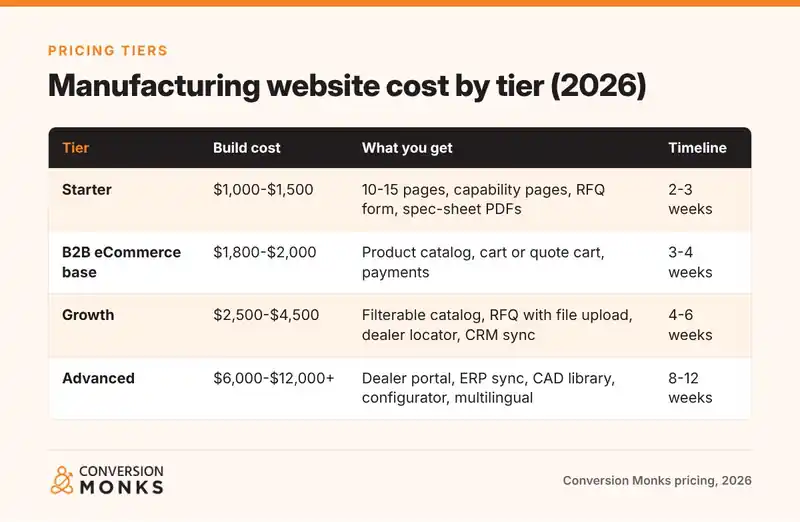
| Tier | Build cost | Best for | Typical scope | Timeline |
|---|---|---|---|---|
| Starter | $1,000-$1,500 | Job shops, contract manufacturers, first websites | 10-15 pages, capabilities, industries served, certifications, RFQ form, spec-sheet PDFs, basic on-page SEO | 2-3 weeks |
| B2B eCommerce base | $1,800-$2,000 | Manufacturers selling standard parts or spares online | Product catalog, cart or quote cart, payment gateway, tax and shipping rules | 3-4 weeks |
| Growth | $2,500-$4,500 | OEMs and suppliers with 50-500 products | Faceted product catalog, RFQ with CAD upload, distributor locator, CRM sync, gated downloads | 4-6 weeks |
| Advanced | $6,000-$12,000+ | Multi-plant, multi-region or dealer-driven businesses | Dealer portal, ERP/PIM sync, CAD library, configurator, multilingual, custom integrations | 8-12 weeks |
Two things move manufacturing website cost between tiers faster than page count: the number of products that need structured specs, and the number of systems the website must talk to. A 40-page site with no integrations is cheaper than a 15-page site that pushes RFQs into an ERP.
What Should a Manufacturing Website Include?
A B2B manufacturing website should answer three buyer questions fast: can you make my part, can you prove quality, and how do I get a quote. That means capability pages, a structured product or capability catalog, a certifications page, downloadable spec sheets, an RFQ form that accepts drawings, and clear contact paths for sales, distributors and job seekers.
Core pages every manufacturer needs
- Capabilities and processes: one page per process (CNC machining, injection molding, sheet metal, assembly) with tolerances, materials, part size limits and equipment lists.
- Industries served: aerospace, medical, automotive, energy. Each page should list the standards you work to for that industry.
- Certifications and quality: ISO 9001, AS9100, ISO 13485, IATF 16949 or ITAR registration, with certificate PDFs and expiry dates.
- Product or capability catalog: structured fields (material, dimensions, finish, lead time) rather than paragraphs, so buyers and search engines can filter.
- RFQ form: fields for quantity, material, tolerance and target date, plus file upload for STEP, IGES, DXF and PDF drawings.
- Downloads: spec sheets, SDS documents, line cards and CAD models, optionally gated behind an email field.
- Distributor or dealer locator and a careers page for plant hiring.
Accessibility is part of the scope, not an extra
If your site serves the public, plan for accessibility from the start. The U.S. Department of Justice’s ADA guidance on web accessibility for businesses points to WCAG as helpful technical guidance and calls out color contrast, alt text, labeled forms and keyboard navigation. It also warns that automated checkers and overlays are not enough on their own, so budget for a manual check of your RFQ and contact forms.
Advanced Feature Add-Ons and What They Cost
Advanced features are priced on top of the base tier and explain most of the variance in manufacturing website cost. The most common add-ons for manufacturers are a faceted product catalog ($500-$1,200), an RFQ form with CAD upload and CRM routing ($250-$500), a dealer portal ($1,500-$3,500) and ERP integration ($1,500-$5,000). Choose the two or three that remove the most manual work from your sales team.
| Add-on | Price range (USD) | What it does |
|---|---|---|
| Faceted product or capability catalog | $500-$1,200 | Filter by material, size, finish, industry; structured product pages with Product schema |
| RFQ form with CAD upload and CRM routing | $250-$500 | Accepts STEP/IGES/DXF/PDF files, assigns the lead to an estimator, sends an auto-reply with an RFQ number |
| Spec-sheet and CAD download library | $300-$700 | Versioned PDFs and CAD files, optional email gate, download tracking in analytics |
| Distributor or dealer locator | $300-$600 | Map search by ZIP code or region, territory rules, dealer detail pages |
| Multilingual setup (per language) | $300-$600 | Translated templates, hreflang tags, language switcher, glossary for technical terms |
| CRM integration (HubSpot or Salesforce) | $300-$800 | Form fields mapped to CRM properties, lifecycle stages, source tracking |
| Dealer or distributor portal | $1,500-$3,500 | Login, customer-specific price lists, order history, marketing asset library |
| Product configurator (CPQ-lite) | $1,500-$4,000 | Rules-based options, live spec summary, quote PDF generation |
| ERP integration | $1,500-$5,000 | Sync products, stock and pricing from the ERP; push RFQs or orders back |
| Accessibility audit and fixes (WCAG 2.2 AA) | $400-$1,000 | Manual audit of templates and forms, contrast and keyboard fixes |
AI Add-Ons (Extra Cost)
AI features are optional and priced separately because they carry ongoing usage costs. For manufacturers, the AI add-ons that pay back fastest are natural-language catalog search, RFQ triage that reads uploaded drawings and emails, and a chatbot trained only on your own spec sheets and manuals. Each one adds $500-$2,500 to your manufacturing website cost, plus a small monthly model and hosting fee.
| AI add-on | Build cost (USD) | How it helps |
|---|---|---|
| AI catalog search | $800-$2,000 | Buyers type “316 stainless flange for 4 inch pipe” and get matching SKUs from structured product data |
| AI RFQ triage | $1,000-$2,500 | Extracts material, quantity, tolerance and due date from RFQ text and attachments, scores fit, routes to the right estimator |
| Spec-sheet chatbot (retrieval-based) | $800-$2,000 | Answers technical questions from your own datasheets and manuals, with links to the source document |
| AI-assisted translation workflow | $400-$1,000 | Machine translation with a locked technical glossary and human review queue for each new language |
| AI product description generator | $500-$1,200 | Turns spec tables into consistent product copy for large catalogs, with editor approval before publishing |
| AI lead enrichment and scoring | $500-$1,200 | Adds company size and industry to RFQs and flags high-fit accounts for faster follow-up |
Keep two guardrails on any AI feature: it should answer only from your own approved content, and every quote, price or tolerance it surfaces should link back to the source document a human approved.
How the Tech Stack Changes Manufacturing Website Cost
The platform changes both the build price and the monthly bill. WordPress with WooCommerce is usually the lowest-cost route for catalog-heavy B2B sites, Shopify suits manufacturers selling standard parts online, and HubSpot CMS fits teams already running HubSpot. Headless or custom builds make sense only when you need deep ERP logic or a portal the others cannot support.
| Stack | Build cost with us (USD) | Platform fees (vendor list price) | Best fit |
|---|---|---|---|
| WordPress + WooCommerce | $1,000-$6,000 | Open source; pay for hosting and plugin licenses | Catalog-heavy B2B sites, RFQ workflows, most budgets |
| Shopify / Shopify Plus | $1,800-$7,000 | Basic $29/mo, Grow $79/mo, Advanced $299/mo billed yearly; Plus from $2,300/mo (Shopify pricing) | Selling standard parts and spares online |
| Webflow | $1,500-$5,000 | Site plans from $15/mo billed yearly; CMS-capable plan $25/mo (Webflow pricing) | Design-led brand sites with a modest catalog |
| HubSpot Content Hub | $2,000-$7,000 | Professional from about $450/mo with 3 seats (HubSpot pricing) | Teams already using HubSpot CRM and sales tools |
| Headless Next.js + Sanity | $5,000-$15,000 | Vercel Pro $20/mo per developer seat; Sanity Growth $15/seat/mo | Large catalogs, multi-site, high-performance builds |
| Custom Laravel or Node.js | $8,000-$20,000+ | Hosting and maintenance only | Dealer portals, configurators and ERP-heavy logic |
If you are weighing platforms for SEO, our Webflow vs. WordPress vs. Wix comparison covers how each handles technical SEO, which matters for long-tail part and capability searches.
ERP and CRM Integration: Where Manufacturing Budgets Slip
ERP integration is the line item most likely to blow up a manufacturing website budget, because cost depends on the ERP’s API, not the website. A one-way nightly product and stock sync typically costs $1,500-$3,000, while a two-way sync that also pushes RFQs or orders back into the ERP runs $3,000-$5,000 or more.
Scope the integration before you get quotes
- Direction: one-way (ERP to website) is far cheaper than two-way.
- Frequency: a nightly batch file is cheaper than real-time API calls.
- Objects: list exactly what moves: products, stock, customer-specific prices, orders, RFQs.
- Access: confirm the ERP exposes a REST or OData API, or whether you need middleware or CSV exports.
- Ownership: decide which system is the source of truth for each field before anyone writes code.
CRM integration is simpler. Mapping RFQ form fields to HubSpot or Salesforce properties, with source tracking and owner assignment, usually takes a few days. It is also where the website starts paying for itself, because every RFQ becomes a tracked deal instead of an inbox thread. Our B2B lead generation services pick up from there.
Ongoing Operational Costs
Running costs are the part of manufacturing website cost that proposals often skip. Plan for $40-$400 per month for most sites, plus maintenance. Hosting, CDN, transactional email, SMS, payment fees, backups, security and plugin licenses are the recurring lines. The figures below are list prices from each vendor’s official pricing page at the time of writing, so confirm them before you sign.
| Cost line | Typical range | Recommended tools (verified list prices) |
|---|---|---|
| Hosting / servers | $10-$100+/mo | Managed WordPress: Kinsta single-site plans from $35/mo billed monthly ($30/mo billed annually). Headless: Vercel Pro $20/mo per developer seat. |
| Domain | Registry cost per year | Cloudflare Registrar charges registry and ICANN fees with no markup |
| SSL certificate | $0 | Free certificates through your host or Cloudflare |
| CDN and WAF | $0-$25/mo | Cloudflare Free, or Pro at $20/mo billed annually ($25/mo billed monthly) (Cloudflare plans) |
| Database | Usually included | Included with WordPress hosting; Sanity Free or Growth at $15/seat/mo for headless content |
| Transactional email | $0-$20/mo | Amazon SES at $0.10 per 1,000 emails, or Postmark Basic at $15/mo for 10,000 emails |
| SMS gateway | Usage-based | Twilio US SMS from $0.0083 per segment plus carrier fees, local numbers $1.15/mo; MSG91 for India-facing OTP and alerts (volume quote) |
| Payment gateway | Per transaction | Stripe 2.9% + 30¢ per domestic card charge; ACH Direct Debit 0.8% capped at $5, which suits large B2B invoices |
| Backups | $0-$15/mo | Daily host backups plus an off-site copy (for example, an S3 bucket) |
| Security | $0-$25/mo | Cloudflare WAF, a security plugin, two-factor login for every admin |
| Maintenance | $75-$300/mo | Core, plugin and theme updates, uptime monitoring, monthly fixes |
| Plugin and app licenses | $100-$600/yr | Forms, translation, catalog filters, backups (varies by stack) |
For most B2B manufacturers, ACH is worth enabling before cards. On a $20,000 order, Stripe’s ACH fee caps at $5, while a domestic card charge at 2.9% + 30¢ would cost $580.30.
Security and Compliance Belong in the Budget
Manufacturers are a frequent target for cybercrime, so website security is a cost line, not an afterthought. NIST’s Manufacturing Extension Partnership notes that the FBI’s latest Internet Crime Report lists critical manufacturing as the top target for ransomware. Budget for a WAF, hardened logins, update discipline and backups from day one.
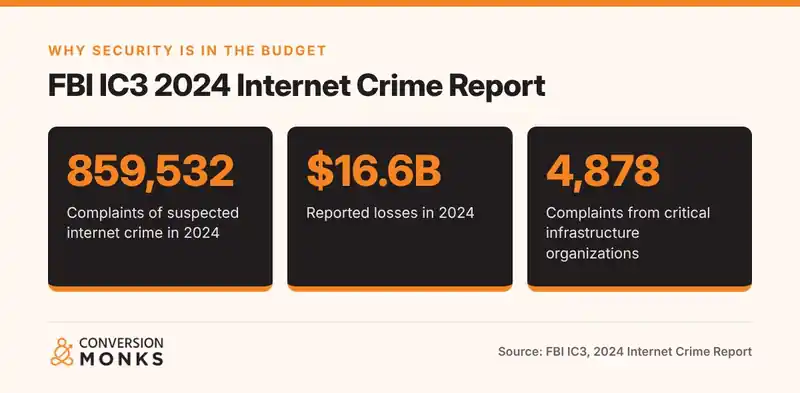
The FBI IC3 2024 Internet Crime Report recorded 859,532 complaints and $16.6 billion in reported losses in 2024, with 4,878 complaints from critical infrastructure organizations. NIST MEP’s cybersecurity resources for manufacturers and the NIST Small Business Cybersecurity Corner for the manufacturing sector are free starting points for a security checklist your web team and IT team can share.
- Put the site behind a web application firewall and rate-limit login and RFQ endpoints.
- Enforce two-factor authentication for every admin and editor account.
- Scan uploaded RFQ files and store them outside the public web root.
- Keep daily backups with at least one off-site copy, and test a restore every quarter.
- If you handle defense work, keep Controlled Unclassified Information out of website forms entirely.
How Long It Takes and How to Scope Your Build
A Starter manufacturing website takes 2-3 weeks, a Growth build 4-6 weeks and an Advanced build with ERP integration 8-12 weeks. The biggest delays are rarely development. They are missing product data, unapproved copy and slow access to ERP or CRM credentials, so collect those before kickoff. Clean inputs keep both the timeline and the manufacturing website cost predictable.
- Export your product list with the fields buyers filter by (material, size, finish, standard).
- Collect certificates, spec sheets, SDS files and CAD models in one folder.
- List every system the site must connect to and who owns the login.
- Pick three competitor or peer sites and note what you like about each.
- Decide which AI add-ons, if any, belong in phase one versus phase two.
For comparison across verticals, see our breakdown of what a contractor website costs. The same tiering logic applies, but manufacturers spend more on catalog structure and integrations.
Frequently Asked Questions
How much does a website for a manufacturing company cost?
A basic informational manufacturing website costs $1,000-$1,500 with our AI-assisted build process. A basic B2B eCommerce or quote-cart site costs $1,800-$2,000. Growth builds with a filterable catalog and CRM-connected RFQ forms run $2,500-$4,500, and advanced builds with ERP sync, a dealer portal or a configurator cost $6,000-$12,000 or more, plus monthly running costs.
What should a manufacturing website include?
At minimum: capability pages for each process, industries served, a certifications and quality page, a structured product or capability catalog, downloadable spec sheets, an RFQ form that accepts CAD and drawing files, and clear contact paths for sales, distributors and job seekers. Accessible forms and fast mobile pages matter as much as design.
How long does it take to build a manufacturing website?
A Starter site takes 2-3 weeks, a B2B eCommerce base 3-4 weeks, a Growth build 4-6 weeks and an Advanced build with ERP integration 8-12 weeks. Timelines depend most on how quickly product data, approved copy, certificates and system access are ready, so gather those before kickoff.
Should a manufacturer use WordPress or a custom build?
Most manufacturers should start on WordPress with WooCommerce or a structured catalog plugin, because it handles large catalogs, RFQ forms and integrations at a low build cost. Choose Shopify if you mainly sell standard parts online, HubSpot CMS if your team lives in HubSpot, and a custom or headless build only for portals, configurators or complex ERP logic.
How much does it cost to maintain a manufacturing website?
Plan for roughly $40-$400 per month in running costs for hosting, CDN, email, SMS, backups, security and licenses, plus $75-$300 per month for maintenance. Payment processing is per transaction, for example Stripe’s 2.9% + 30 cents for domestic cards or 0.8% capped at $5 for ACH Direct Debit.
Can a manufacturing website integrate with an ERP?
Yes, if the ERP exposes an API, supports scheduled exports or works with middleware. A one-way nightly sync of products, stock and pricing typically costs $1,500-$3,000, and a two-way sync that also sends RFQs or orders back into the ERP costs $3,000-$5,000 or more. Confirm API access before requesting quotes.
Planning a new manufacturing website? Book a free website scoping call and we will map your catalog, RFQ flow and integrations into a fixed-price manufacturing website cost estimate with the tier, add-ons and running costs spelled out.
Written by Neha Verma, co-founder of Conversion Monks.