

AEO for manufacturing is the work of making your capability pages, specs and certifications easy for AI answer engines to find, trust and quote, so your company is named when an engineer or buyer asks ChatGPT, Perplexity, Gemini or Google AI Mode for a supplier. It builds on technical SEO, but the unit of success changes from a ranking to a citation.
That shift matters because supplier research now starts in a chat window for a large share of buyers. In a 2025 survey of more than 350 B2B buyers by Responsive, one in four said they use generative AI more often than traditional search when researching suppliers, and 48% of U.S. respondents said they use it to find vendors. This guide covers the questions buyers ask, the manufacturer schema markup that supports your answers, entity signals, AI crawler access and how to measure AI search for manufacturers.
What Is AEO for Manufacturing?
AEO for manufacturing means structuring a manufacturer’s website so AI systems can extract precise, verifiable answers about what you make, how, to what tolerance, under which certifications and for which industries. The goal is to be the cited source when a buyer asks an AI assistant to shortlist suppliers, compare processes or check a capability.
Classic SEO asks whether a page ranks for “5-axis CNC machining Ohio.” Answer engine optimization for manufacturing asks a different question: when an AI tool builds an answer to “Which ISO 9001 shops in Ohio can hold ±0.0005 in. on titanium?”, does it have enough clean, specific text from your site to include you? Google’s own guidance says there are no special technical requirements for AI Overviews or AI Mode beyond being indexed and eligible for a snippet, so the gains come from content specificity, structure and trust signals rather than tricks.
| Traditional SEO | AEO for manufacturers | |
|---|---|---|
| Unit of success | Ranking position and clicks | Being named or cited inside an AI answer |
| Query shape | Short keywords (“precision machining”) | Long, constraint-heavy prompts (material + tolerance + certification + region) |
| Winning content | Broad service pages | Answer-first capability pages with spec tables and FAQs |
| Trust signals | Backlinks, domain authority | Consistent entity data, certifications, third-party listings, reviews |
| Measurement | Search Console rankings | Prompt panels, citation reports, AI referral traffic, RFQ attribution |
How B2B Buyers Use AI to Find Manufacturing Suppliers
Engineers and procurement teams use AI assistants to build a long list, filter it by hard constraints and draft RFQ questions. They type full requirements, not keywords, and they expect the assistant to name companies. If your site does not state those constraints in plain text, the AI has nothing to match.
The same Responsive research found that buyers typically start with five to eight vendors and narrow to three or fewer before contacting anyone, so being absent from the AI-generated long list often means you never see the RFQ. Map the prompts your buyers use to the page that should answer each one:
| Buying stage | Typical AI prompt | Page that should answer it |
|---|---|---|
| Discovery | Contract manufacturers for medical device enclosures in the Midwest | Industry page (medical) + location signals |
| Capability check | Who can laser-cut 3/8 in. stainless with ±0.005 in. tolerance? | Process capability page with spec table |
| Compliance filter | ITAR-registered machine shops that are AS9100 certified | Quality and certifications page |
| Commercial fit | Low-volume injection molding, MOQ under 500 parts, 4-week lead time | Capability page: MOQ, lead time, tooling |
| Comparison | Die casting vs. CNC machining for an aluminum housing at 5,000 units | Engineering guide or comparison article |
| Validation | Is [Company] a reliable supplier? Reviews and certifications | About page, case studies, third-party profiles |
Collect real prompts from your sales team’s RFQ emails, trade-show questions and the questions customers ask on calls. Those phrases become your H2s, your FAQ entries and the prompt panel you track later.
Build Answer-First Capability Pages AI Engines Can Quote
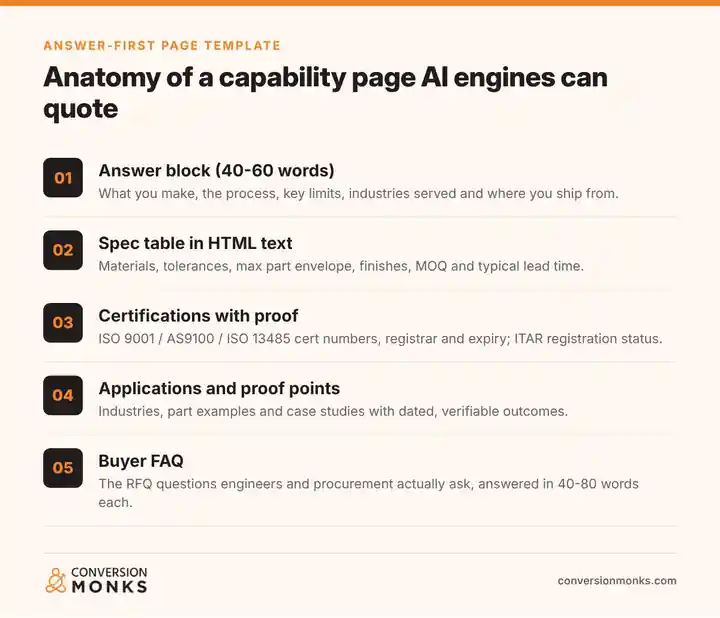
An AI-quotable capability page opens with a 40-60 word answer that names the process, the key limits, the industries served and where you ship from, then backs it with a spec table, certification proof, application examples and a buyer FAQ. Each element answers a constraint a buyer types into an AI prompt.
The five blocks of a capability page
- Answer block: “We provide 5-axis CNC machining of aluminum, stainless steel and titanium parts up to 30 x 20 x 16 in., holding tolerances to ±0.0005 in., for aerospace and medical OEMs, shipping from Dayton, Ohio.” One paragraph, no adjectives that cannot be verified.
- Spec table in HTML text: materials, tolerances, maximum part envelope, surface finishes, secondary operations, MOQ, typical lead time. Never only in an image or PDF.
- Certifications with proof: standard, certificate number, registrar and expiry date, plus a link to the certificate.
- Applications and proof points: industries, sample parts and case studies with dated, verifiable outcomes.
- Buyer FAQ: five or six RFQ-style questions answered in 40-80 words each, marked up as FAQ content.
Write claims you can defend. If a page says “Made in USA,” the FTC’s Made in USA standard for business marketing requires that the product be “all or virtually all” made in the United States, and that standard applies to websites and online ads. AI engines repeat what your pages say, so an inaccurate claim spreads further than it used to.
Turn PDF datasheets into HTML
Most manufacturers keep their best technical content in PDF datasheets and line cards. Publish the key specs as an HTML table on the product or capability page and keep the PDF as a download. Text in the page body is easier to parse, easier to keep consistent with your structured data and easier for an AI system to quote with a link back to you.
Manufacturer Schema Markup: Organization, Product and Certification JSON-LD
Manufacturer schema markup uses Organization for the company entity, Product with a manufacturer property and additionalProperty values for specs, and the schema.org Certification type for ISO or AS9100 credentials. It does not unlock AI features by itself, but it makes your facts unambiguous and must match the visible text on the page.
There is no schema.org type called “Manufacturer.” Use Organization (or a more specific subtype) for the company and reference it from each Product through the manufacturer property. Add your NAICS code with the naics property; the U.S. Census Bureau’s NAICS Sector 31-33 manufacturing tables show how your industry code is classified. Schema.org lists Certification properties such as issuedBy, certificationIdentification, validFrom and expires.
Organization JSON-LD for a manufacturer
<script type="application/ld+json">
{
  "@context": "https://schema.org",
  "@type": "Organization",
  "@id": "https://www.example-mfg.com/#org",
  "name": "Example Precision Manufacturing, Inc.",
  "url": "https://www.example-mfg.com/",
  "logo": "https://www.example-mfg.com/logo.png",
  "naics": "332710",
  "foundingDate": "1987",
  "address": {
    "@type": "PostalAddress",
    "streetAddress": "100 Industrial Pkwy",
    "addressLocality": "Dayton",
    "addressRegion": "OH",
    "postalCode": "45402",
    "addressCountry": "US"
  },
  "sameAs": [
    "https://www.linkedin.com/company/example-precision",
    "https://www.youtube.com/@exampleprecision"
  ],
  "hasCertification": {
    "@type": "Certification",
    "name": "ISO 9001:2015",
    "certificationIdentification": "CERT-123456",
    "issuedBy": { "@type": "Organization", "name": "Example Registrar LLC" },
    "validFrom": "2024-03-01",
    "expires": "2027-02-28"
  }
}
</script>
Product JSON-LD with specs as additionalProperty
<script type="application/ld+json">
{
  "@context": "https://schema.org",
  "@type": "Product",
  "name": "5-Axis CNC Machined Titanium Bracket",
  "description": "Ti-6Al-4V bracket machined to +/-0.0005 in. for aerospace assemblies.",
  "manufacturer": { "@id": "https://www.example-mfg.com/#org" },
  "material": "Titanium Ti-6Al-4V",
  "additionalProperty": [
    { "@type": "PropertyValue", "name": "Tolerance", "value": "0.0005", "unitText": "in" },
    { "@type": "PropertyValue", "name": "Max part envelope", "value": "30 x 20 x 16", "unitText": "in" },
    { "@type": "PropertyValue", "name": "Minimum order quantity", "value": "25" }
  ]
}
</script>
Validate both blocks with the Schema Markup Validator and Google’s Rich Results Test, then confirm every value appears in the page text. Google states that structured data should match the visible content, and a mismatch is a quick way to lose trust.
Entity Signals: Make Your Company Unambiguous Across the Web
AI engines decide which manufacturer to name by matching consistent facts across many sources: your website, LinkedIn, industrial directories, distributor pages, trade associations and government registrations. The more consistently your name, address, NAICS code, certifications and capabilities appear, the more confidently a model can connect a buyer’s question to your company.
Entity work is the part of AEO for manufacturing that most plants skip, because it lives outside the website. Start with the profiles buyers and AI systems already read:
- One canonical company name (with or without “Inc.”, but the same everywhere) and one address format.
- sameAs links in Organization schema to the profiles you control: LinkedIn, YouTube, industrial directory listings and trade association member pages.
- Directory and marketplace profiles that repeat your capability limits and certifications in the same words as your site.
- Distributor and partner pages that describe your products accurately and link to the right product URL.
- Your state’s NIST MEP center: the NIST Manufacturing Extension Partnership runs centers in all 50 states and Puerto Rico, and many publish manufacturer directories and supplier-matching programs worth joining.
Treat ITAR and certifications as entity facts
Compliance status is one of the hardest filters a buyer applies, so state it precisely. Under 22 CFR 122.1, manufacturers of defense articles must register with the State Department’s DDTC even if they do not export. If you are registered, say “ITAR registered” on your quality page and keep it current; do not write “ITAR certified,” which is not a credential DDTC issues. List each ISO, AS9100, IATF 16949 or ISO 13485 certificate with its scope, because buyers and AI assistants both check scope.
Reviews and proof follow the same rule. Case studies with a named industry, the part, the process and a dated result give an AI something concrete to cite. Quote real customers only with their permission, and never publish testimonials you cannot attribute.
Technical Crawlability for AI Bots on Manufacturer Sites
AI search engines can only cite pages their crawlers can reach and read. Allow the search-focused AI crawlers in robots.txt and at your CDN or firewall, render capability content as server-side HTML, keep specs out of gated forms, and maintain an XML sitemap with accurate lastmod dates.
OpenAI’s crawler documentation separates OAI-SearchBot, which surfaces sites in ChatGPT search, from GPTBot, which collects training data, and notes that robots.txt changes can take about 24 hours to apply. Google AI Overviews and AI Mode use Googlebot, while the Google-Extended token only controls use in other Google AI systems. A typical policy for a manufacturer that wants AI search visibility but not model training looks like this:
# Search and answer engines: allow
User-agent: OAI-SearchBot
Allow: /

User-agent: PerplexityBot
Allow: /

User-agent: Claude-SearchBot
Allow: /

User-agent: Googlebot
Allow: /

# Model training: your choice (shown here as opt-out)
User-agent: GPTBot
Disallow: /

User-agent: Google-Extended
Disallow: /

Sitemap: https://www.example-mfg.com/sitemap_index.xml
Whether to opt out of training is a business decision, not an SEO requirement. What matters for AEO for manufacturing is that the search crawlers are not blocked by accident, which is common when a WAF or bot-management rule treats every non-Google user agent as a scraper.
Common manufacturer-site blockers
- Product configurators and spec finders that render only in JavaScript.
- Spec sheets available only as PDFs behind a lead form. Gate the CAD files, not the specs.
- Duplicate product URLs from distributor feeds or faceted filters without canonical tags.
- Cloudflare or WAF rules that challenge OAI-SearchBot or PerplexityBot. Check your bot logs for 403 responses.
- Orphan capability pages with no internal links from navigation or industry pages.
Our 100-point SEO checklist covers the crawl, indexation and internal-linking fundamentals that AI visibility still depends on.
How to Track AI Search for Manufacturers: Citations, Referrals and RFQs
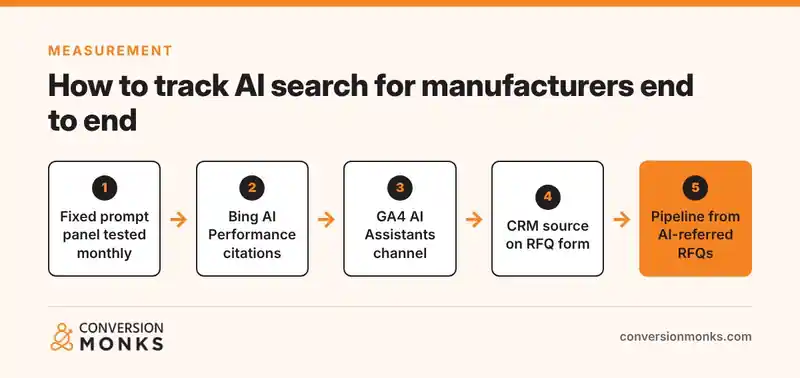
Track AI search for manufacturers at four levels: whether you are cited (a fixed prompt panel and Bing’s AI Performance report), whether citations send traffic (a GA4 AI channel), whether that traffic converts (RFQ source capture in your CRM) and whether it becomes pipeline. Rankings alone no longer show the whole picture.
1. Run a fixed prompt panel
Write 20-30 prompts from your buyer-question map and run them monthly in ChatGPT, Perplexity, Gemini, Copilot and Google AI Mode. Record whether you are named, which URL is cited and which competitors appear. Keep the wording identical each month so changes reflect your work, not your phrasing.
2. Read citation data from Bing Webmaster Tools
Bing Webmaster Tools now includes an AI Performance report that shows how often your pages are cited in Microsoft Copilot and Bing’s AI-generated answers, the grounding queries behind those citations and which URLs are cited. It is the closest thing to a citation console available today. Google Search Console includes AI Overviews and AI Mode traffic inside the standard Web performance report, without a separate filter.
3. Create an AI channel in GA4
In GA4, go to Admin > Data display > Channel groups > Create new channel group, add a channel named “AI Assistants” and set the condition to Source matches regex:
^(chatgpt\.com|chat\.openai\.com|perplexity\.ai|www\.perplexity\.ai|gemini\.google\.com|copilot\.microsoft\.com|claude\.ai)$Use Reorder to place the channel above Referral, then save. Google’s custom channel group documentation notes that traffic is assigned to the first matching channel, that standard properties can create two custom groups and that custom groups can be applied to reports retroactively.
4. Capture the source on the RFQ form
Add a hidden field that stores the session source and a required “How did you find us?” field with an “AI assistant (ChatGPT, Perplexity, etc.)” option. Many AI-influenced buyers arrive later through direct or branded search, so the self-reported field catches what analytics misses. Pass both values into your CRM so you can report AI-influenced RFQs and won revenue.
A 90-Day AEO Rollout Plan for Manufacturers
Most manufacturers can make measurable progress on AEO for manufacturing in 90 days by fixing crawl access first, rebuilding their top revenue capability pages in an answer-first format, adding schema and entity consistency, and then expanding FAQ and comparison content while tracking citations monthly.
| Weeks | Focus | Deliverables |
|---|---|---|
| 1-2 | Baseline and access | Prompt panel baseline, robots.txt and WAF review, Bing Webmaster Tools and GA4 AI channel set up |
| 3-6 | Top capability pages | Answer block, HTML spec table, certifications and FAQ on the 5-10 pages tied to most revenue |
| 7-8 | Schema and entities | Organization, Product and Certification JSON-LD; sameAs; directory and distributor profile cleanup |
| 9-12 | Depth and measurement | Comparison guides, industry pages, RFQ source field, first month-over-month citation report |
If you are also rebuilding the site, plan these page templates into the build. Our guide to how much it costs to build a manufacturing website breaks down where capability pages, product catalogs and integrations sit in a 2026 budget.
Frequently Asked Questions
What is AEO for manufacturers?
AEO for manufacturers is answer engine optimization applied to industrial websites. It structures capability pages, specs, certifications and FAQs so AI tools like ChatGPT, Perplexity, Gemini and Google AI Mode can extract accurate answers and cite the manufacturer when buyers ask for suppliers that meet specific material, tolerance, volume or compliance requirements.
How do B2B buyers use AI to find suppliers?
B2B buyers use AI assistants to build supplier long lists, filter them by constraints such as certifications, tolerances, MOQ and location, compare processes and draft RFQ questions. A 2025 Responsive survey of 350+ buyers found one in four use generative AI more than traditional search for supplier research, so missing from AI answers can mean missing the RFQ.
What schema should a manufacturing website use?
Use Organization schema for the company with address, NAICS code, sameAs links and hasCertification; Product schema with a manufacturer reference, material and additionalProperty values for specs; and FAQPage markup for buyer FAQs. Schema.org has no Manufacturer type, and every structured data value should match the visible text on the page.
How can a manufacturer appear in ChatGPT answers?
Allow OAI-SearchBot in robots.txt and at your CDN, publish answer-first capability pages with specs in HTML text, keep company facts consistent across LinkedIn, directories and distributor sites, and earn mentions on trusted third-party pages. Then run a monthly prompt panel in ChatGPT to see whether you are named and which URL is cited.
Is AEO different from SEO for manufacturers?
AEO builds on SEO rather than replacing it. Both need crawlable, indexed, well-linked pages. The difference is the target: SEO aims for rankings and clicks, while AEO aims for your company to be named or cited inside AI-generated answers, which rewards precise specs, consistent entity data and question-led page structure.
How do you track AI referral traffic in GA4?
Create a custom channel group in GA4 under Admin, Data display, Channel groups. Add an AI Assistants channel where Source matches a regex covering chatgpt.com, perplexity.ai, gemini.google.com, copilot.microsoft.com and claude.ai, move it above Referral and save. Pair it with an RFQ form field that asks how the buyer found you.
Want to know whether AI engines can find and cite your plant’s capabilities? Conversion Monks runs AEO audits for manufacturers that cover crawl access, capability pages, schema, entity consistency and AI referral tracking, alongside our SEO and AEO services. Book a free consultation call to get your manufacturing AEO audit.
Written by Neha Verma, co-founder of Conversion Monks.