

AEO for industrial equipment manufacturers is the work of turning spec sheets, manuals and application notes into pages AI engines can read, trust and quote, so your machine is named when an engineer asks ChatGPT, Perplexity, Gemini or Google AI Mode what to buy. The core asset is the model-level spec page, published as HTML rather than a PDF.
Our AEO guide for manufacturing companies covers supplier and capability pages. This guide to AEO for industrial equipment manufacturers goes one level down, to the machine: units, test conditions, compatibility, maintenance questions and the schema that describes them. It also shows what Google says schema will not do for you.
What Is AEO for Industrial Equipment Manufacturers?
AEO for industrial equipment manufacturers means structuring each model, series and application page so an AI system can extract exact ratings, limits and fit, then cite your URL. It differs from general industrial SEO because the unit of work is the spec row and its conditions, not the keyword or the capability page.
Start with what Google actually requires. Its documentation on AI features and your website says there are no additional requirements or special schema for AI Overviews or AI Mode. A page must be indexed and eligible to show with a snippet. Google also notes these features may use query fan-out, running related searches across subtopics, which favors a site with a page for each subtopic of a buying decision.
That sets the priority order for AEO for industrial equipment manufacturers: accurate facts first, machine-readable access second, markup third. Google’s guide to optimizing for generative AI features says you do not need llms.txt, content chunking or special markup for Search, and it rewards content that goes beyond common knowledge. Your test data, duty cycles and field limits are exactly that kind of content.
What Questions Do Equipment Buyers Ask AI?
Equipment buyers ask constraint-heavy questions: duty, capacity, operating environment, compatibility, standards and total cost of ownership. Owners ask a second set about maintenance, parts and fault codes. Map each prompt to one page on your site. If no page states the constraint in plain text, an AI answer has nothing from you to use.
Many of these readers are technical. BLS occupational estimates for machinery manufacturing counted 116,140 architecture and engineering jobs in the sector in May 2023, about 10% of its 1,122,230 total, so many readers at OEM accounts read a spec the way an engineer does. They look for the test condition first, then the number.
| Stage | Typical prompt | Page that should answer it |
|---|---|---|
| Sizing | What size rotary screw compressor do I need for 200 cfm at 125 psi? | Sizing guide linked to model pages |
| Fit | Which vertical mixers handle 40,000 cP adhesive in a Class I Division 2 area? | Application page with limits |
| Comparison | Rotary screw vs. reciprocating compressor for a 24/7 line | Comparison page with a table |
| Compatibility | Does the XR-200 filter fit older XR-150 units? | Parts and supersession page |
| Maintenance | How often should I change the separator element? | Maintenance FAQ tied to a manual revision |
| Validation | Who services this machine in Ohio? What is the lead time? | Dealer locator and model page |
Good AEO for industrial equipment manufacturers starts with real wording from RFQ emails, service tickets, on-site search and call notes. Service tickets are especially useful because they show exact fault codes and part numbers that no keyword tool reports.
Should Spec Sheets Be PDFs or HTML?
In AEO for industrial equipment manufacturers, publish specs in HTML and keep the PDF as a download. Google can index PDFs, but an HTML table stays current, carries internal links, supports structured data that matches visible text and gives AI systems a specific page to cite. The PDF is the printable copy.
Google lists PDF among its indexable file types, so PDFs are not invisible. The practical problems are different. Scanned sheets carry no text layer, one PDF often covers ten models, and old revisions stay live on dealer sites. When a PDF is the only source, one URL has to answer every question about every model in the series.
Three rules keep the conversion clean:
- One row, one fact. Split “10-14 bar, 460 V” into separate rows so each value has its own unit and condition.
- Keep neutral CAD next to the spec. Link STEP files from the model page. NIST’s Digital Thread for Smart Manufacturing project built on standards such as STEP, MTConnect and QIF because product data needs to move between systems without being retyped.
- Gate CAD, not ratings. A form in front of the spec table hides it from crawlers as well as from buyers.
Public posting is also a release decision. Under 15 CFR 734.7, unclassified technology made available to the public without restrictions is generally treated as “published,” and the rule has exceptions. Have your export compliance lead review anything beyond catalog-level data before it goes live. This is general information, not legal advice.
A spec page template AI engines can quote
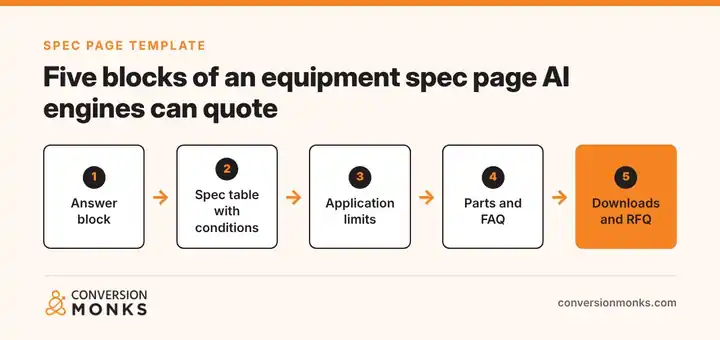
This template is the core of AEO for industrial equipment manufacturers. Open with a plain answer block: “The RS-37 is a 37 kW (50 hp) oil-injected rotary screw compressor delivering 6,200 L/min (219 cfm) at 7 bar for continuous-duty plant air.” Then give every rating a condition. This illustrative table shows the pattern:
| Spec | Value | Condition or source |
|---|---|---|
| Motor power | 37 kW (50 hp) | Nameplate, 460 V, 60 Hz |
| Free air delivery | 6,200 L/min (219 cfm) | At 7 bar, measured per ISO 1217 |
| Maximum working pressure | 10 bar (145 psi) | Standard build |
| Ambient operating range | 2 to 46 °C (36 to 115 °F) | Above range requires high-ambient kit |
| Weight | 1,150 kg (2,535 lb) | Without dryer |
| Spec revision | Rev. C, October 2026 | Matches datasheet RS-37-DS-C |
The right-hand column is what most spec pages miss. Without a condition, 219 cfm is a claim. With one, an engineer can compare it, and an AI answer can repeat it accurately.
What Schema Works for Industrial Products?
Use Product schema with brand, mpn, manufacturer and additionalProperty values for each spec, plus Organization on the company entity. It describes facts precisely, but it is not required for AI features, and a catalog page with no price, rating or review will usually not earn a product rich result.
Product schema for machinery works best when each spec row becomes a PropertyValue. Use numbers in value, minValue and maxValue, and set unitCode to a UN/CEFACT Common Code: KWT for kilowatt, BAR for bar, L2 for liters per minute, KGM for kilogram, CEL for degrees Celsius, VLT for volts. Reserve unitText for cases with no standard code.
<script type="application/ld+json">
{
  "@context": "https://schema.org",
  "@type": "Product",
  "name": "Example RS-37 Rotary Screw Air Compressor",
  "mpn": "RS-37-460",
  "brand": { "@type": "Brand", "name": "Example Air" },
  "manufacturer": { "@id": "https://www.example-air.com/#org" },
  "category": "Rotary screw air compressors",
  "additionalProperty": [
    { "@type": "PropertyValue", "name": "Motor power", "value": 37, "unitCode": "KWT" },
    { "@type": "PropertyValue", "name": "Free air delivery at 7 bar", "value": 6200, "unitCode": "L2" },
    { "@type": "PropertyValue", "name": "Maximum working pressure", "value": 10, "unitCode": "BAR" },
    { "@type": "PropertyValue", "name": "Ambient operating range", "minValue": 2, "maxValue": 46, "unitCode": "CEL" },
    { "@type": "PropertyValue", "name": "Supply voltage", "value": 460, "unitCode": "VLT" },
    { "@type": "PropertyValue", "name": "Weight", "value": 1150, "unitCode": "KGM" }
  ]
}
</script>
Three limits matter when you budget schema work into AEO for industrial equipment manufacturers:
- Rich results need more. Google’s product snippet documentation requires one of review, aggregateRating or offers. Quote-only machines often have none, and you should not invent them to pass a validator.
- Merchant listings need a checkout. Google’s merchant listing guidelines cover only pages where a shopper can buy the product, which may suit your parts store but rarely a quote-only machine.
- Series variants are narrow. Google’s product variant documentation supports variesBy for color, size, suggested age, suggested gender, material and pattern. Voltage and capacity are not on that list, so give each sellable configuration its own Product with its own mpn and specs.
Keep the same values on the page and in the JSON-LD. Generate both from one PIM or spreadsheet if you can, so a spec change cannot update one and miss the other.
Which Pages Beyond Spec Sheets Earn Citations?
Application, comparison, compatibility and maintenance pages answer questions a spec table cannot, such as which model fits a duty and what to do at 8,000 hours. These pages extend AEO for industrial equipment manufacturers into the subtopics AI systems explore during query fan-out, connecting models to problems buyers describe.
- Application pages: one duty per page, for example “compressed air for bottling lines,” with the recommended model, the limits and a statement of when another product is the better choice.
- Comparison pages: your own product types side by side in an HTML table. Stick to facts you can support when you name a competitor.
- Compatibility and supersession tables: old model, new model, what changed and which part numbers carry over.
- Maintenance FAQ: intervals, consumables and fault codes, each tied to a manual revision.
Safety content needs extra care in AEO for industrial equipment manufacturers, because an AI answer can strip away your caveats. Quote service steps from the approved manual and link to it instead of paraphrasing. OSHA’s lockout/tagout standard, 29 CFR 1910.147 requires employers to document specific steps for shutting down, isolating, blocking and securing machines, so state on the page that site-specific energy control procedures still apply.
How Do Entity, Dealer and Review Signals Affect AI Answers?
AI engines connect a model to your brand through repeated, consistent identifiers: company name, model name, part number and specs across your site, dealers and directories. When dealer pages carry old ratings, assistants can repeat them. For AEO for industrial equipment manufacturers, consistency has a direct payoff, because a wrong rating in an answer can cost you the shortlist.
- Fix the identifiers: one model naming convention, one mpn format, and GTINs only where GS1 issued them.
- Set sameAs on Organization: point to LinkedIn, YouTube, trade association and directory profiles you control. The Organization example in our manufacturing guide applies here unchanged.
- Give dealers a spec feed: send current specs and images each quarter, then audit the top dealers for retired ratings.
- Choose directories by buyer use: no AI vendor publishes a list of the directories it trusts, so favor the ones your buyers already use.
- Collect real proof: attributed customer stories, published test reports and genuine third-party reviews. Google’s guide warns against chasing inauthentic mentions.
Before you plan new pages, price the rebuild against your catalog. Our guide to what an industrial equipment manufacturer website costs breaks out catalogs, CAD libraries, configurators and dealer portals.
How Do You Keep Spec Pages Crawlable for AI Bots?
Serve spec content in the initial HTML, allow the search crawlers in robots.txt and at your WAF, and keep each model on its own canonical URL. Configurators and tabbed spec widgets are the common failure on equipment sites, because values load only after a click or a JavaScript call that some crawlers may not run.
# Check in server logs and at the WAF, not only in robots.txt
User-agent: OAI-SearchBot
Allow: /

User-agent: PerplexityBot
Allow: /

User-agent: Googlebot
Allow: /

# Training crawlers are a separate business decision
User-agent: GPTBot
Disallow: /- Separate search from training. OpenAI’s crawler documentation treats OAI-SearchBot and GPTBot independently, and sites that opt out of OAI-SearchBot will not appear in ChatGPT search answers.
- Allow bots at the firewall. Perplexity’s crawler documentation advises matching both user agent and published IP ranges in WAF rules.
- Render configurators on the server. Publish a static spec page for each standard configuration, and use the configurator for options.
- Watch page weight. Googlebot processes the first 2MB of a supported file type and the first 64MB of a PDF, so a long catalog page can lose its lower rows.
Our SEO and AEO services include this crawl review, and a quick test works for any team doing AEO for industrial equipment manufacturers: load a model page with JavaScript disabled, and confirm the spec table is still there.
How Do You Track AI Citations and Referral Traffic?
Measure AEO for industrial equipment manufacturers at four levels: fixed prompt tests, platform citation reports, referral traffic in GA4 and RFQ source capture in your CRM. No single tool shows the whole path, and equipment sales cycles are long, so log the page cited and the spec quoted as well as the mention itself.
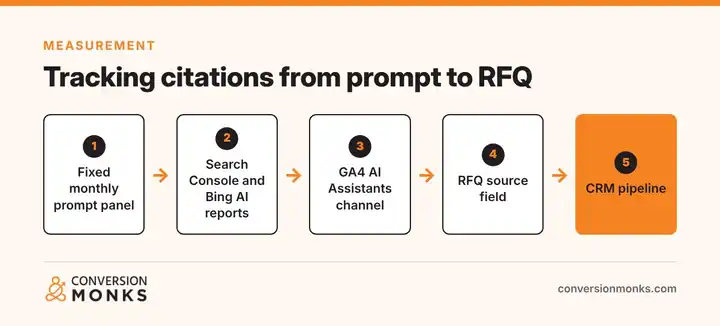
- Prompt panel: run 20-30 fixed prompts monthly in each assistant. Record whether you are named, which URL is cited and whether the quoted spec is correct.
- Search Console: the Generative AI performance report shows impressions for AI Overviews and AI Mode by page, country, date and device. Sites without enough impressions may not see it, and it does not report clicks.
- Bing Webmaster Tools: the AI Performance report shows total citations, cited pages and grounding queries.
- GA4: under Admin > Data display > Channel groups, add an AI Assistants channel above Referral with Source matching the regex below.
- RFQ form: add an “AI assistant” option to “How did you find us?” and pass it to your CRM with the session source.
^(chatgpt\.com|chat\.openai\.com|(www\.)?perplexity\.ai|gemini\.google\.com|copilot\.microsoft\.com|claude\.ai)$Frequently Asked Questions
How do I get my equipment cited in AI Overviews?
Make sure each model page is indexed and eligible for a snippet, because Google lists no extra requirements for AI Overviews. Then state ratings, conditions and application limits in HTML text, and build pages for the related questions buyers ask. Citations are not guaranteed, so test a fixed set of prompts each month and check the Search Console Generative AI report.
Should spec sheets be PDFs or HTML?
Use both, with HTML as the source. Put ratings, dimensions and limits in an HTML table on a model-specific URL and offer the PDF as a download. Google can index text-based PDFs, but HTML stays easier to update, links to related pages and supports structured data that matches the visible spec table on the same page.
What schema works for industrial products?
Use Product with name, brand, mpn, manufacturer and additionalProperty values, with a UN/CEFACT unitCode on each measured spec. Add Organization for the company and FAQPage markup where a real FAQ exists. Schema clarifies facts, but it is not required for AI features, and product rich results need a review, a rating or an offer.
How do engineers search for equipment?
Engineers search by constraint, not brand. They enter capacity, pressure, duty cycle, media, operating environment and required standards, then compare specs and look for CAD and manuals. In AI assistants they write those constraints as full sentences. Pages that show ratings with test conditions, plus downloadable files, match this behavior better than broad product category pages.
How long does AEO for industrial equipment manufacturers take?
Crawl fixes can apply quickly: OpenAI says robots.txt changes can take about 24 hours for search results. Content changes depend on recrawling, which Google says can take several days to several months. Start AEO for industrial equipment manufacturers with your top revenue models, baseline a prompt panel first and judge progress monthly rather than weekly.
How do you track AI citations for equipment pages?
Measure AEO for industrial equipment manufacturers with a monthly prompt panel, the Search Console Generative AI report, Bing Webmaster Tools AI Performance data and a GA4 channel for AI referrals. Add an AI assistant option to your RFQ form and store it in your CRM. Also record whether quoted specs are correct, because an inaccurate citation still needs a fix.
Want to know whether AI engines can read your spec pages? Conversion Monks runs AEO audits for industrial equipment manufacturers covering spec pages, schema, crawler access, dealer data and citation tracking. Request your equipment AEO audit and we will show you where to start.
Written by Neha Verma, co-founder of Conversion Monks.
No Comments
[…] the site is scoped, plan how AI engines will read it. Our guide to AEO for industrial equipment manufacturers shows how to build spec pages that get cited in AI […]