

A realistic industrial equipment manufacturer website cost starts at $1,000-$1,500 for a clean informational site and reaches $6,000-$12,000 or more once you add a product configurator, CAD downloads, a dealer portal and ERP sync. Equipment makers sit at the expensive end of B2B web work because one machine can carry dozens of configurations, a parts tree and years of manuals.
This guide prices those pieces one at a time: build tiers, equipment-specific add-ons, AI features, tech stack and the monthly bills. It goes deeper than our general manufacturing website cost guide, which suits job shops and component suppliers. Our prices reflect an India-based team that builds with AI-assisted workflows, and every third-party fee below was checked against the vendor’s own pricing page in November 2026.
What Is the Industrial Equipment Manufacturer Website Cost in 2026?
Most machinery makers land in one of four bands. A Starter site costs $1,000-$1,500, a basic parts store costs $1,800-$2,000, a Growth build with a series and model catalog costs $2,500-$4,500, and an Advanced build with a configurator, dealer portal and ERP sync costs $6,000-$12,000 or more before monthly running costs.
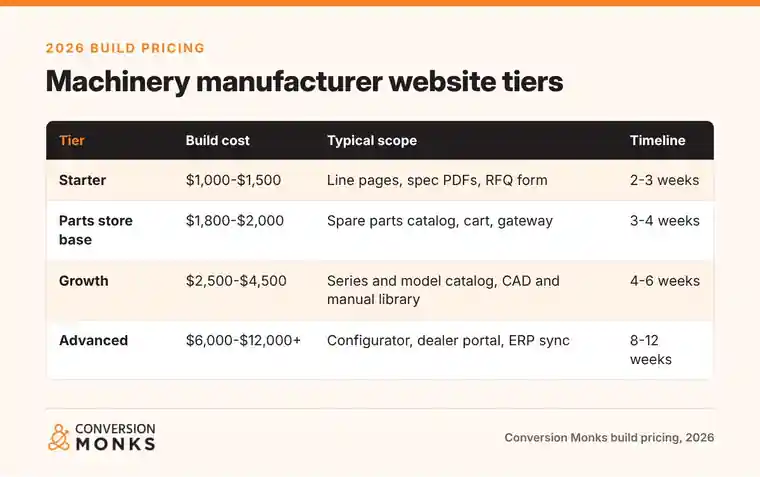
| Tier | Build cost | Best for | Typical scope | Timeline |
|---|---|---|---|---|
| Starter | $1,000-$1,500 | Single-line builders, first websites | 10-15 pages, product line pages, spec PDFs, RFQ form, basic on-page SEO | 2-3 weeks |
| Parts store base | $1,800-$2,000 | OEMs selling wear parts and consumables | Parts catalog, cart or quote cart, payment gateway, tax and shipping rules | 3-4 weeks |
| Growth | $2,500-$4,500 | OEMs with 10-100 models | Line, series and model pages, comparison tables, CAD and manual library, dealer locator, CRM sync | 4-6 weeks |
| Advanced | $6,000-$12,000+ | Dealer-driven and multi-region OEMs | Configurator, dealer portal, parts lookup, ERP or PIM sync, multilingual | 8-12 weeks |
Add-ons sit on top of each tier, so a Growth site with one portal can overlap the Advanced band. Two variables drive the final industrial equipment manufacturer website cost more than page count: how many option combinations each model has, and how many business systems the site must read from or write to.
What Features Does an Industrial Equipment Website Need?
An industrial equipment website needs a catalog organized by line, series and model, structured specifications, comparison tables, datasheets, CAD files, manuals, an RFQ form and a dealer locator. Unlike a general manufacturer site, it must also serve current owners with spare parts, service requests and documentation tied to a model or serial number.
NIST’s Manufacturing Extension Partnership guidance on marketing and sales calls the website a company’s most important sales and marketing tool. For machinery, that tool has four audiences: engineers specifying a machine, procurement teams comparing vendors, dealers selling it and maintenance crews keeping it running.
Build the catalog around your data model
The catalog is the largest cost driver, so settle its structure before design starts. Most machine lines map to five levels, each with its own template or data table.
- Product line: applications served and links to each series.
- Series: shared design, shared options and a comparison table across models.
- Model: capacity, power, dimensions, weight, certifications, datasheet and CAD.
- Configuration: voltage, drive, controls and material options with dependency rules.
- Owner content: parts lists, manuals and service bulletins matched to model and serial range.
Series pages map well to schema markup. Google documents ProductGroup and variant structured data for parent products with variants. Its supported variesBy values are consumer-leaning (size, color, material, pattern), so use size for capacity and carry engineering specs in additionalProperty:
{
  "@context": "https://schema.org",
  "@type": "ProductGroup",
  "name": "Example VX Series Vertical Mixer",
  "productGroupID": "VX",
  "brand": { "@type": "Brand", "name": "Example Machinery" },
  "variesBy": ["https://schema.org/size"],
  "hasVariant": [{
    "@type": "Product",
    "sku": "VX-500",
    "name": "VX-500 Vertical Mixer, 500 L",
    "size": "500 L",
    "additionalProperty": [{
      "@type": "PropertyValue",
      "name": "Motor power",
      "value": "15",
      "unitCode": "KWT"
    }]
  }]
}
Treat manuals and safety content as a product
OSHA’s guide to safeguarding equipment and preventing amputations advises employers to base maintenance programs on the manufacturer’s recommendations and notes they can buy safeguards from the original manufacturer. A searchable library of manuals, guarding details, lockout information and replacement guards answers that need directly. Version every document and show which serial range it covers, so nobody follows an outdated procedure.
Advanced Feature Add-Ons and What They Cost
Advanced features are priced on top of the base tier and explain most of the variance in industrial equipment manufacturer website cost quotes. For equipment makers, the common add-ons are a rules-based configurator ($1,500-$4,000), a dealer portal ($1,500-$3,500), a CAD and manual library ($300-$700) and an interactive parts lookup ($800-$2,500). Choose those that remove the most manual work.
| Add-on | Price range (USD) | What it does |
|---|---|---|
| Series and model catalog | $500-$1,200 | Filterable specs, comparison tables, structured model pages |
| CAD and manual download library | $300-$700 | Versioned STEP, PDF and DXF files, optional email gate, download tracking |
| Browser 3D model viewer | $800-$2,000 | Rotate and inspect a lightweight model without CAD software |
| Rules-based configurator (CPQ-lite) | $1,500-$4,000 | Option logic, live spec summary, quote PDF |
| 3D visual configurator | $4,000-$9,000 | Options update a prepared 3D model in the browser |
| Dealer or distributor portal | $1,500-$3,500 | Login, price lists, order history, sales asset library |
| Dealer locator | $300-$600 | ZIP or region search, territory rules, dealer pages |
| Interactive parts lookup | $800-$2,500 | Exploded diagrams linked to part numbers and the cart |
| Serial number lookup | $500-$1,200 | Matches a machine to its manuals, parts and warranty status |
| Service request and warranty forms | $300-$800 | Model and serial capture, photo upload, routing to service or dealer |
| ERP integration | $1,500-$5,000 | Syncs stock and pricing, pushes orders or RFQs back |
| PIM integration | $1,000-$3,000 | Feeds specs from one source of truth |
| Multilingual setup (per language) | $300-$600 | Translated templates, hreflang tags, technical glossary |
| Accessibility audit and fixes (WCAG 2.2 AA) | $400-$1,000 | Manual testing of templates, forms and portal screens |
Product configurator cost: three levels
Configurator cost follows the complexity of the rules, not the visuals. Before you request quotes, count the options, list which ones exclude each other and decide whether the output is a quote, a bill of materials or a drawing.
- Rules-based ($1,500-$4,000): forms and logic that block invalid combinations and produce a quote request.
- 3D visual ($4,000-$9,000): the same logic with prepared 3D models that change with each selection.
- CAD-generating (vendor quote): parametric models produce drawings per order, usually through a licensed CPQ or CAD automation platform plus integration work.
CAD downloads: self-hosted or catalog platform
A self-hosted library suits a small set of fixed models. Catalog platforms suit large or parametric ranges. For example, CADENAS PARTcommunity lists over 100 CAD formats and supports iFrame embedding, but manufacturer catalog licensing is by quote. Never publish native assembly files. Export simplified envelopes and hide proprietary internals.
Dealer portal cost depends on pricing data
A dealer portal website with static price lists is a modest project. The price jumps when each dealer needs account-specific pricing, live stock or order status from the ERP, because that adds an integration line. Confirm that your ERP exposes an API before you fix this part of the industrial equipment manufacturer website cost.
AI Add-Ons (Extra Cost)
AI features are optional and priced separately because they carry usage fees. For machinery makers, the most useful are a service assistant trained on your manuals, natural-language parts search and a guided equipment selector. Each adds $400-$2,500 to your industrial equipment manufacturer website cost, plus a monthly model and hosting bill that depends on traffic and document volume.
| AI add-on | Build cost (USD) | How it helps |
|---|---|---|
| Manual and service assistant | $800-$2,000 | Answers from approved manuals with a link to the source page |
| Natural-language parts search | $800-$2,000 | Finds parts from plain descriptions, model numbers or old part numbers |
| Guided equipment selector | $1,000-$2,500 | Turns application questions into a short list of suitable models |
| AI RFQ triage | $1,000-$2,500 | Pulls capacity, voltage, site and timeline from requests, then routes them |
| Parts data extraction | $500-$1,500 | Converts legacy PDF parts books into structured lists for human review |
| Manual translation workflow | $400-$1,000 | Machine translation with a locked glossary and human review queue |
Set hard limits on any assistant that discusses machines. It should answer only from approved documents, quote safety steps exactly as written and hand off to a technician when it cannot find a source. It should never estimate load limits, guard clearances or lockout steps.
How the Tech Stack Changes Industrial Equipment Manufacturer Website Cost
The platform affects both the build price and the monthly bill. WordPress with WooCommerce is usually the lowest-cost route for catalog-heavy machinery sites, Shopify suits parts stores, and HubSpot CMS fits teams already on HubSpot. Headless or custom builds earn their cost only when configurators, portals or ERP logic outgrow what those platforms handle.
| Stack | Build cost with us (USD) | Platform fees (vendor list price) | Best fit |
|---|---|---|---|
| WordPress + WooCommerce | $1,000-$6,000 | Open source; pay for hosting and plugins | Catalog sites, RFQ flows, most budgets |
| Shopify / Shopify Plus | $1,800-$7,000 | Basic $29, Grow $79, Advanced $299/mo billed yearly; Plus from $2,300/mo (Shopify pricing) | Spare parts stores |
| Webflow | $1,500-$5,000 | Basic $15, Premium $25/mo billed yearly (Webflow pricing) | Design-led sites with modest catalogs |
| HubSpot Content Hub | $2,000-$7,000 | Professional from $450/mo with 3 Core Seats (HubSpot pricing) | Teams using HubSpot CRM |
| Headless Next.js + Sanity | $5,000-$15,000 | Vercel Pro $20/mo (Vercel pricing); Sanity Growth $15/seat/mo (Sanity pricing) | Large catalogs, 3D viewers, multi-site |
| Custom Laravel or Node.js | $8,000-$20,000+ | Hosting and maintenance only | Dealer portals, configurators, ERP-heavy logic |
A hybrid is often the best value: keep marketing and catalog pages on WordPress or Webflow, and run the configurator or portal as a separate app on a subdomain.
Ongoing Operational Costs
Your industrial equipment manufacturer website cost does not stop at launch. Plan for roughly $40-$400 per month in platform and infrastructure costs, plus $75-$300 per month for maintenance. CAD files, videos and portals push machinery sites toward the top of that range. The list prices below come from each vendor’s pricing page, so confirm them before signing.
| Cost line | Typical range | Recommended tools (verified list prices) |
|---|---|---|
| Hosting / servers | $30-$100+/mo | Kinsta Single 20GB at $35/mo, or $30/mo billed annually. Vercel Pro for headless. |
| Domain | Registry cost per year | Cloudflare Registrar or your existing registrar |
| SSL certificate | $0 | Free certificate from your host or Cloudflare |
| CDN and WAF | $0-$200/mo | Cloudflare Free; Pro $20/mo billed annually; Business $200/mo billed annually |
| Database | Usually included | Included with hosting; Sanity Growth for headless content |
| Transactional email | $0-$20/mo | Amazon SES $0.10 per 1,000 emails; Postmark Basic $15/mo for 10,000; SendGrid by plan |
| SMS gateway | Usage-based | Twilio US SMS $0.0083 per segment plus carrier fees, local number $1.15/mo; MSG91 India from ₹0.25 per SMS at 5,000 volume, lower at higher volumes |
| Payment gateway | Per transaction | Stripe 2.9% + 30¢ per domestic card charge; ACH Direct Debit 0.8%, capped at $5 |
| Backups | $0-$15/mo | Daily host backups plus an off-site copy |
| Security | $0-$25/mo | WAF rules, security plugin, two-factor login |
| Maintenance | $75-$300/mo | Updates, uptime monitoring, monthly fixes |
| Plugin and app licenses | $100-$600/yr | Forms, translation, filters, backups; more for a CPQ license |
Offer ACH for larger parts orders. On a $1,200 order, a domestic card charge costs $35.10 at 2.9% + 30¢, while Stripe’s ACH fee stops at the $5 cap.
Compliance Items to Budget For
Machinery websites carry compliance work that brochure sites do not. Technical downloads may raise export control questions, public-facing forms should be accessible, and portals hold dealer and customer data. None of these is usually a large build cost, but each needs an owner and review time before launch. Treat this section as planning input and take specific questions to counsel.
- Export controls: under Part 734 of the Export Administration Regulations, technology made available to the public without restrictions, including by internet posting, is generally treated as published, with listed exceptions. Posting is hard to undo, so have your export lead review CAD files and detailed drawings first, and keep controlled data out of public downloads.
- Accessibility: the Department of Justice guidance on web accessibility and the ADA applies to businesses open to the public and treats WCAG as helpful guidance, not a detailed regulation. Parts stores, RFQ forms and service forms deserve manual testing.
- Portal security: use two-factor login, role-based access and audit logs. Keep Controlled Unclassified Information out of website forms entirely.
How to Scope Your Build and Control the Cost
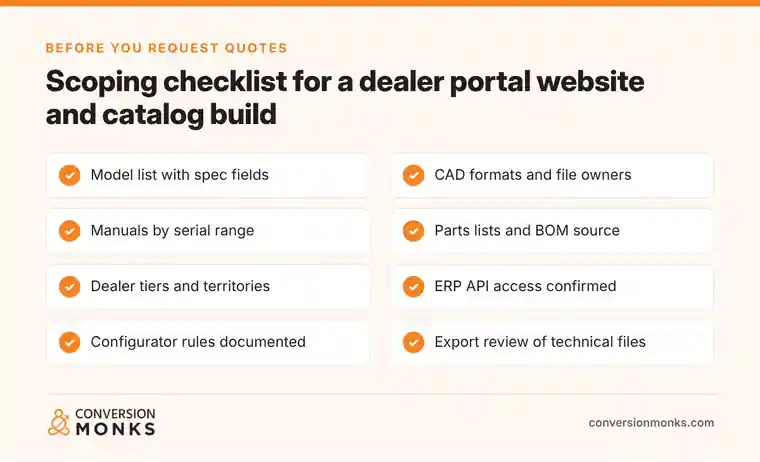
The fastest way to control your industrial equipment manufacturer website cost is to phase it. Launch the catalog, CAD and manual library first, add parts sales second, and add the configurator and dealer portal once you have usage data. Clean product data, documented option rules and confirmed ERP access prevent most budget overruns.
- Phase 1: Growth tier catalog, manual and CAD library, dealer locator, CRM-connected RFQs.
- Phase 2: parts store, parts lookup, service request forms.
- Phase 3: configurator, dealer portal, ERP sync, AI assistant.
Once RFQs flow into a CRM, our B2B lead generation services can pick up demand generation. To get these pages cited in AI answers, see our guide to AEO for manufacturing companies.
Frequently Asked Questions
How much does a website for an industrial equipment manufacturer cost?
The industrial equipment manufacturer website cost starts at $1,000-$1,500 for a basic informational site from our AI-assisted team, and a basic parts store costs $1,800-$2,000. A Growth build with a series and model catalog plus CAD and manual libraries runs $2,500-$4,500. Advanced builds with a configurator, dealer portal and ERP sync cost $6,000-$12,000 or more, plus monthly running costs.
How much does a product configurator cost?
A rules-based configurator that validates options and generates a quote PDF costs about $1,500-$4,000 from our team. A 3D visual configurator using prepared models costs about $4,000-$9,000. Costs rise with the number of options, dependency rules and CPQ or ERP connections. Parametric CAD generation usually needs a licensed platform, which vendors price by quote.
What features does an industrial equipment website need?
It needs a line, series and model catalog with structured specs, comparison tables, downloadable datasheets, a manuals library, CAD downloads, an RFQ form, a dealer locator, spare parts lookup and service request forms. Machines bought for years of use also need content for current owners, so the website should serve operators, maintenance teams and dealers as well as new buyers.
Should equipment manufacturers sell parts online?
Often yes, for fast-moving wear parts and consumables with clear fitment data. A parts store gives owners a faster route to the correct item and can be added to the site for $1,800-$2,000 as a base. Check dealer agreements first, because direct sales can conflict with territories. One option is to route online orders to the assigned dealer instead.
How do you add CAD downloads to a website?
Store STEP and other neutral files in a versioned library linked to each model, then add a download button with an optional email gate and analytics event. A self-hosted library costs $300-$700. A browser 3D preview needs lightweight converted models. Large catalogs can use a hosted CAD platform instead. Clear each file for export before publishing it.
What is a dealer portal and what does it cost?
A dealer portal is a login area where authorized distributors see their own price lists, place orders, track warranty claims and download sales assets. A basic version costs about $1,500-$3,500 from our team. Customer-specific pricing drawn from an ERP adds integration work of $1,500-$5,000, so the data source decides most of the final budget.
Planning a new equipment website? Book a free website scoping call and we will map your catalog, CAD library, dealer needs and integrations into a fixed-price quote, with your industrial equipment manufacturer website cost broken down by tier, add-on and monthly running costs.
Written by Neha Verma, co-founder of Conversion Monks.